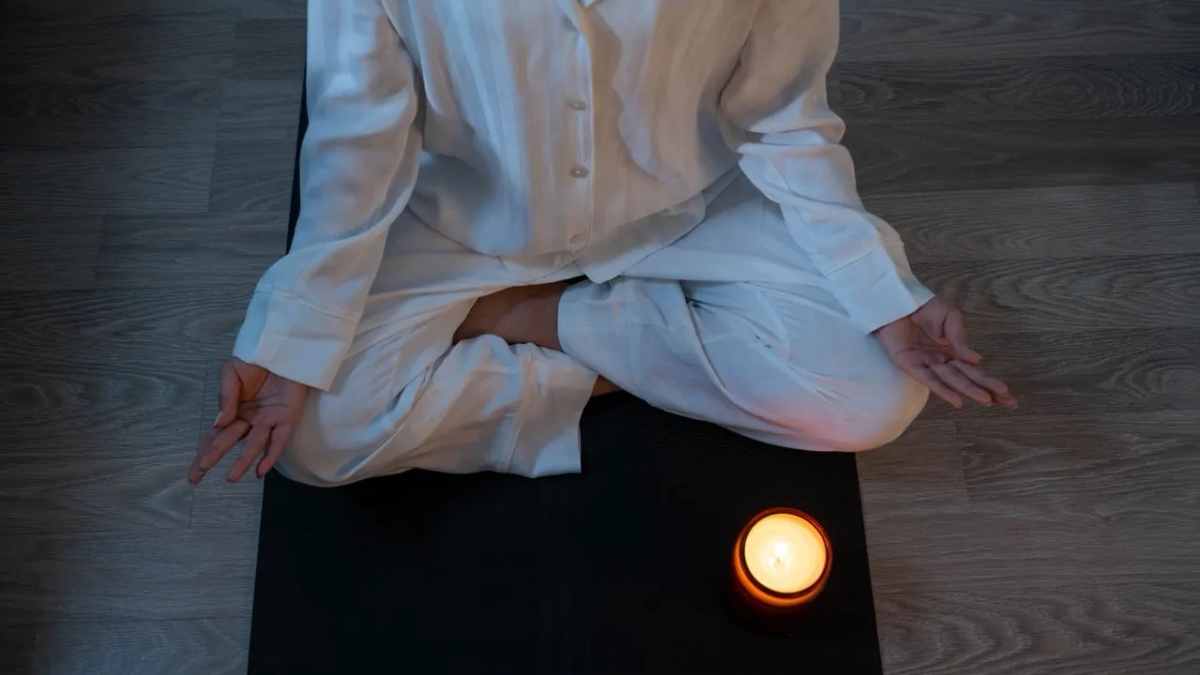
Meditation for sleep is the practice of gently redirecting your attention — away from the noise of the day and toward something quieter — so your body and mind can settle into rest. It does not require special equipment, years of experience, or a perfectly silent room. For most people, even a few minutes of simple, repeated practice can make the transition to sleep feel noticeably less effortful.
The evidence behind it is encouraging. Research consistently shows that regular meditation reduces physiological arousal — the kind of low-level alertness that can keep you lying awake even when you feel tired. It tends to slow your heart rate, ease muscle tension, and quiet the mental chatter that often peaks the moment you lie down.
This guide covers everything in one place: what meditation is, how different techniques work, and how to bring each one into your evening. Each section links to a deeper post if you want to explore further. Start with whatever feels most accessible, and go from there.
What meditation is and why it helps you sleep
Meditation is the practice of directing your attention deliberately and repeatedly toward a chosen focus — a breath, a word, a physical sensation — rather than letting thoughts run unchecked. It is not about achieving a blank mind. It is about giving your attention somewhere quieter to settle.
For sleep, that matters because the biggest obstacle is usually not tiredness — it is a mind that will not slow down. Replaying conversations, planning tomorrow, worrying about things you cannot change at eleven at night. Meditation does not make those thoughts disappear. It gives you a way to stop feeding them so much energy.
With regular practice, this becomes easier. Your nervous system learns to associate the practice with calm, which means even a few minutes before bed can begin to signal to your body that the day is winding down.
If you are new to all of this, A Beginner’s Guide to Meditation for Calmer Evenings walks through five approachable styles — from breath awareness to guided sessions — and helps you find one that feels simple enough to repeat.
Using your breath to wind down in the evening
Breath is the most immediate tool you have for shifting your nervous system toward calm. You carry it with you everywhere, it costs nothing, and it responds to deliberate attention faster than almost anything else.
The mechanism is straightforward. When you slow your breathing — and particularly when you extend your exhale — you activate the parasympathetic nervous system. That is the part of your nervous system responsible for rest and recovery. A longer exhale signals safety to your body. Heart rate slows. Muscle tension releases. The vigilance that carried you through the day begins to ease.
You do not need a formal technique to start. Even three or four slow, conscious breaths — breathing in for a count of four, breathing out for a count of six or eight — can shift how you feel within a minute.
A few simple patterns worth trying:
- Extended exhale breathing — breathe in for 4 counts, out for 6 or 8
- Box breathing — 4 counts in, hold 4, out 4, hold 4 (keep this gentle at bedtime)
- Simple breath awareness — lie down and notice the physical sensation of each breath, without counting or adjusting
The goal is not control — it is attention. The moment you bring your focus to your breath, you are already stepping back from the mental loops that make sleep harder.
This guide to using your breath to wind down in the evening goes deeper on how each pattern works and when to use it.
How to calm a racing mind before bed
A racing mind at bedtime is one of the most common sleep complaints — and one of the most frustrating, because the instinct is to try harder to stop thinking, which tends to make it worse.
The most effective approaches do not fight the mind. They redirect it. Mindfulness is the practice of noticing what is happening in the present moment — thoughts, sensations, sounds — without judgment and without trying to push anything away. At bedtime, this can mean noticing the feeling of the pillow beneath your head, the rhythm of your breath, the temperature of the air. Not analysing, not solving. Just observing.
This works because racing thoughts are often thoughts about the future or the past. Bringing attention to immediate physical experience anchors you in the present, which is somewhere your nervous system can more easily relax.
A few other approaches that can help:
- Write it down first. A short brain dump onto paper — not a screen — before bed can reduce the mental effort of holding things in mind.
- Body scanning. Move your attention slowly from the top of your head to your feet, noticing any sensation without trying to change it.
- Labelling thoughts. When a thought arises, name it gently — “planning,” “worrying,” “remembering” — and let it pass.
A body scan is a meditation technique where you move attention systematically through each part of the body, simply noticing what is there. It is one of the gentlest ways to ease a restless mind without needing to think your way out of thinking.
Seven steps that may help calm a racing mind at bedtime offers a practical, gentle sequence to work through on difficult nights.
Bringing mindfulness into your evening
Mindfulness is awareness of the present moment, held with curiosity rather than judgment. Outside of formal meditation, it can be woven into the ordinary things you already do in the evening — washing up, making tea, dimming the lights — so that the second half of your day gradually shifts into a slower gear.
This matters because sleep does not begin the moment you close your eyes. It begins in the hour or two before bed, when your body starts preparing for rest. When that time is spent at the same pace and intensity as the rest of the day — stimulating, reactive, screen-heavy — the transition to sleep becomes abrupt and difficult.
Small moments of mindful attention in the evening can change that texture. Not a formal practice, necessarily. Just pausing. Noticing. Choosing to do one thing at a time instead of several.
Simple ways to bring mindfulness into your evening:
- Put your phone down ten minutes earlier than usual and simply sit
- Make a warm drink slowly, noticing the smell, the warmth in your hands
- Step outside briefly and pay attention to the air and the quiet
- Dim the lights and notice how the room feels different
None of these are meditation in the traditional sense. But they create the conditions that make sleep easier to find.
How to slow down and bring more mindfulness into your evening has more on building these small practices into the natural rhythm of your night.
A simple gratitude practice before sleep
A gratitude practice before sleep is a short, deliberate reflection on the things that went well during the day — however small — held in mind with genuine attention rather than rushed performance.
This is not positive thinking in the forced sense. It is a gentle redirection of where your attention rests as you move toward sleep. The mind tends to default to reviewing problems and risks, which is useful for survival but not for falling asleep. Deliberately recalling something that felt good — a good cup of coffee, a moment of connection, something you noticed outside — shifts that default pattern.
It does not need to take long. Three things, held gently in mind for thirty seconds each, is enough to notice a difference in how settled you feel going into sleep.
You can make it even simpler:
- Think of one moment today when you felt okay, or better than okay
- Let yourself stay with that memory for a full breath or two
- Notice what it felt like in your body — not just what happened
The point is not to manufacture contentment. It is to give your attention something warm to rest on as the day closes.
A simple gratitude practice to calm your mind before bed walks through how to make this feel easy and genuine rather than effortful.
What to do when your mind starts spiralling
Spiralling thoughts at night have a particular quality: they gain momentum. One worry leads to a bigger worry, which leads to catastrophising, which leads to lying awake feeling much worse than when you started. The spiral feels automatic, but it is not inevitable.
Mindfulness offers a way to interrupt it — not by arguing with the thoughts or trying to prove them wrong, but by noticing them as thoughts rather than facts. A thought is an event in the mind. It does not have to direct the whole evening.
One approach that works for many people is to name what is happening: “I notice I am spiralling.” That small act of observation creates a little distance between you and the thought pattern. It is enough to slow the momentum.
From there, returning to something physical — your breath, the sensation of the mattress beneath you, the sounds outside — anchors attention somewhere the spiral cannot follow.
If spiralling thoughts are a regular feature of your evenings, it is worth knowing that this is a common experience and there are gentle, evidence-informed approaches to it.
When your mind starts spiralling — mindfulness may help goes into more detail on what to do in those moments and why softer approaches tend to work better than forceful ones.
Why patience matters more than effort with sleep
One of the most counterproductive things you can do when you cannot sleep is to try harder. Effort and sleep are not compatible states. The more urgently you pursue sleep, the more alert your nervous system becomes.
This is not a personal failing. It is biology. Sleep happens when the conditions are right — when you are physically tired, your body temperature has dropped, the room is dark and quiet, and your mind is not in high-alert mode. Pushing hard for sleep creates exactly the wrong internal conditions.
Patience, in this context, is an active practice. It means lying quietly without demanding that things be different. It means noticing discomfort without adding a layer of frustration on top of it. It means trusting that your body knows how to sleep, and that the most helpful thing you can do is get out of the way.
This is harder than it sounds when you have been awake for an hour and have an early morning. But the willingness to stop fighting is, paradoxically, often what allows sleep to arrive.
Why patience helps more than pressure when you cannot sleep explores this idea more gently and gives you something practical to hold onto on difficult nights.
Using curiosity instead of frustration at night
Frustration with wakefulness adds arousal to an already alert state. Curiosity does the opposite. When you approach the experience of lying awake with a quality of interest rather than irritation — noticing how your body feels, what thoughts arise, what sounds you can hear — you stop being in conflict with the moment.
Curiosity is not pretending everything is fine. It is a genuinely different way of relating to experience. Instead of “why can’t I sleep,” it is “what is happening right now?” That shift does not fix everything immediately, but it removes one layer of activation that was making it harder.
This approach connects directly to mindfulness practice. The quality of open, non-judgmental attention that meditation cultivates is the same quality that makes wakefulness in the night less distressing — and, over time, less frequent.
How curiosity can help when you overthink at night looks at this in more depth and offers a few gentle reframes for moments when your thoughts are running the show.
Frequently Asked Questions
Does meditation actually help you fall asleep?
Meditation supports sleep by reducing the physiological and mental arousal that often keeps people awake. It does not work instantly for everyone, but regular practice — even five minutes most evenings — tends to make the transition to sleep feel easier over time. Many people notice a difference within the first one to two weeks.
How long should I meditate before bed?
Five to ten minutes is enough for most people, especially when starting out. The goal is not a long session — it is a consistent, gentle one. A short practice you can repeat most evenings will make more difference than an occasional longer one.
What if I fall asleep during meditation?
Falling asleep during a bedtime practice is not a problem at all. For sleep purposes, it may even mean things are working. If you want to stay awake through the session itself, try sitting up rather than lying down, and keep the practice brief.
What is the best type of meditation for sleep?
There is no single best type. Breath awareness, body scanning, and guided meditation are all good starting points. The most useful style is whichever one feels simple enough for you to repeat on a quiet evening without much effort or setup.
My mind keeps wandering. Am I doing it wrong?
No — noticing that your mind has wandered and gently bringing it back is the practice itself. A wandering mind is not a sign of failure. Every time you return your attention, you are doing exactly what meditation asks of you. Over time, that returning becomes easier.

Sheepherd writes calm, practical guides about sleep, evening routines, and creating a more restful home life.